---
title: What Is Cybersecurity Risk Management? Frameworks, Skills, and Strategies for Modern Enterprises
description: Learn how to build a cybersecurity risk management framework, apply the 5 C’s and 4 risk responses, and strengthen resilience with JANUS Associates.
image: https://info.janusassociates.com/hubfs/JANUS%20Associates%20Cybersecurity%20and%20Risk%20Management%20Framework.jpg
---
[JANUS](https://janusassociates.com/)
Protecting our clients' data & best interests since 1988.
[203-251-0200](tel:203-251-0200)
[Menu](https://info.janusassociates.com/blog/cybersecurity-risk-management-framework-janus-associates#menu)
- [Menu Item](https://janusassociates.com/)
- [Cybersecurity Services](https://janusassociates.com/services/)
- [CMMC Readiness Services](https://janusassociates.com/services/cmmc-advisory-readiness-services/)
- [Risk Assessments](https://janusassociates.com/services/assessments/)
- [Advanced Penetration Testing](https://janusassociates.com/services/penetration-testing/)
- [VCISO Services](https://janusassociates.com/services/cio-ciso-services/)
- [Business Resilience](https://janusassociates.com/services/business-resilience/)
- [Enterprise Risk & Compliance](https://janusassociates.com/solutions/enterprise-risk-compliance/)
- [ARC-AMPE (MARS-E) Compliance](https://janusassociates.com/services/mars-e/)
- [Security Architecture & Implementation](https://janusassociates.com/solutions/security-architecture-implementation/)
- [Strategy & Advice](https://janusassociates.com/solutions/strategy/)
- [Employee Training & Awareness](https://janusassociates.com/solutions/training-awareness/)
- [Sectors](https://janusassociates.com/sectors/)
- [Commercial](https://janusassociates.com/sectors/commercial/)
- [Education & Nonprofit](https://janusassociates.com/sectors/education-non-profit/)
- [Financial Services](https://janusassociates.com/sectors/financial-services/)
- [Gaming, Casinos, & Entertainment](https://janusassociates.com/sectors/gaming-casinos-entertainment-2/)
- [Government](https://janusassociates.com/sectors/government/)
- [Healthcare](https://janusassociates.com/sectors/health-care/)
- [Legal](https://janusassociates.com/sectors/legal/)
- [Manufacturing & Critical Infrastructure](https://janusassociates.com/sectors/critical-infrastructure/)
- [About Us](https://janusassociates.com/about/)
- [Leadership Team](https://janusassociates.com/about/leadership/)
- [Contracts & Certifications](https://janusassociates.com/about/contracts-certifications/)
- [Cyber Security Framework Expertise](https://janusassociates.com/cyber-security-framework-expertise/)
- [Partnerships](https://info.janusassociates.com/partnerships)
- [Information Hub](https://info.janusassociates.com/blog)
- [Blog](https://info.janusassociates.com/blog)
- [Case Studies](https://janusassociates.com/ebooks/)
- [Federal Guidance & Frameworks](https://janusassociates.com/resources/)
- [Small Business Resources](https://janusassociates.com/small-business-resources/)
- [Videos](https://janusassociates.com/video/)
- [Contact Us](https://janusassociates.com/contact/)
- [Request Consultation](https://info.janusassociates.com/request-a-consultation)
Blog
What Is Cybersecurity Risk Management? Frameworks, Skills, and Strategies for Modern Enterprises
15:00
# What Is Cybersecurity Risk Management? Frameworks, Skills, and Strategies for Modern Enterprises
Cyber risk isn’t just an IT problem; it’s something every leader needs to take seriously. These days, regulators, customers, and insurers all want to see a clear, consistent plan for managing cyber security risks, not just a bunch of tools or one-off fixes. For CISOs, CIOs, compliance leaders, and IT directors, the question is no longer *if* to invest, but *how* to govern that investment through a disciplined framework.
## [](https://info.janusassociates.com/request-a-consultation)
## What Is Risk Management in Cybersecurity?
A formal risk management framework ensures cybersecurity decisions are aligned with business goals and compliance needs while keeping risks within acceptable limits.
Risk management in cybersecurity is the structured process of identifying your most important digital assets, understanding how they can be attacked, deciding how much risk you are willing to tolerate, and implementing controls to keep risk within that threshold.[A **cyber security risk management framework**](https://www.gsa.gov/system/files/Risk-Management-Strategy-(RMS)-%5BCIO-IT-Security-18-91-Rev-6%5D.pdf) formalizes this process so that decisions tie back to business objectives, regulatory requirements, and resilience targets.
Modern programs often align with the [NIST Cybersecurity Framework’s core functions: Identify, Protect, Detect, Respond, Recover](https://www.nist.gov/cyberframework/getting-started/online-learning/five-functions), which provide a common language for managing cybersecurity‑related risk. For example, a practical cybersecurity risk management example is mapping your core systems (EHR platforms, payment processing, manufacturing control systems, or cloud workloads) to the NIST functions, then prioritizing controls such as strong identity management, network segmentation, monitoring, and recovery testing based on their business criticality.
For organizations that need experienced guidance, a trusted, independent cybersecurity and compliance consulting firm like JANUS Associates can help translate these frameworks into a tailored cyber security risk management approach that reflects your threat profile and regulatory landscape.
[](https://info.janusassociates.com/hs/cta/wi/redirect?encryptedPayload=AVxigLJihN1sGMjOZBwbfNEGJ6ZiVPrxJSKpNQwQS4Zn%2B%2Fg%2BO8cRWzg31OOP0KnOllOxzVt7ufbiViUT6mjWwDgQsOBgTalddiyfpRCR%2FKfE8IjwOMbvxOCfcaXM9USxu1cdjE1bfxxNIHoNYm9Y%2BlsL99jUDqFGweppl8%2Fpxrq8Jjq4V%2FwLrC3%2F0Xs%3D&webInteractiveContentId=206325932557&portalId=4114417)
## Core Skills for Effective Cybersecurity Risk Management
Sustained cyber resilience requires a blend of technical, analytical, and leadership capabilities. Core skills include:
### Risk analysis and IT risk assessment
Teams must be able to inventory assets, map threats and vulnerabilities, and estimate likelihood and impact using structured **IT risk assessment** methodologies. This includes reviewing technical weaknesses through vulnerability assessments and advanced penetration testing, as well as evaluating process gaps and third‑party risks.
### Knowledge of frameworks and regulations
Practitioners should understand frameworks such as [the NIST Cybersecurity Framework](https://nvlpubs.nist.gov/nistpubs/CSWP/NIST.CSWP.29.pdf) and NIST SP 800‑53, ISO 27001, and sector‑specific regulations like HIPAA and PCI DSS. Familiarity with these frameworks is key to addressing common audit pain points, such as unclear control ownership, insufficient documentation, and gaps in evidence collection. By designing controls that map directly to framework requirements, practitioners can reduce risk while proactively resolving the issues that often cause audit delays or findings, leading to more consistent, smoother audits.
### Communication and stakeholder alignment
Leaders must explain complex threats and mitigation options in business language, tie investments to risk reduction and regulatory expectations, and secure sponsorship from executives and the board. Clear reporting on control effectiveness and residual risk is essential to govern a sustainable **[cyber risk strategy](https://www.gsa.gov/system/files/Risk-Management-Strategy-(RMS)-%5BCIO-IT-Security-18-91-Rev-6%5D.pdf).**
### Incident response and business continuity mindset
Effective cybersecurity risk management assumes incidents will occur and prioritizes preparation, response, and recovery. Skills here include developing and testing incident response plans, coordinating with legal and communications, and aligning cybersecurity with business continuity and disaster recovery plans.
JANUS Associates brings senior‑level, vendor‑neutral cybersecurity consulting expertise to organizations that need support in any of these areas, from **vulnerability management** and penetration testing to policy, training, and governance. For many clients, leveraging [comprehensive cybersecurity and IT risk assessments](https://www.janusassociates.com/services/) is the catalyst for building a disciplined cyber security risk management framework.
[](https://info.janusassociates.com/hs/cta/wi/redirect?encryptedPayload=AVxigLIbLmEXsFIOFbEqrgNTX2X5vNTGBJ9U1LgI3%2BqgyGyOSUGTHNzkFNZ653aNE9l56s%2BjTOUG0iw8DJeCcZ0sBDo%2FkwmfTYVIf8vhMmDwmfA6Mby6MmAS9ddzoFI19QNXP7BDL7lZX0oZpWFTgOORav0ixaRWt0QZKDS3hXeZxUitcEXo9kUnrDVR%2BP0Sf2ee%2ByQErDDzHQ7Pm2g%3D&webInteractiveContentId=197944013912&portalId=4114417)
## The 5 C’s of Cybersecurity
A practical way to frame your **cyber risk strategy** is through the 5 C’s of cybersecurity: Change, Compliance, Cost, Continuity, and Coverage.
### Change
Technology, threats, and business models evolve constantly, [from cloud migrations to AI adoption and OT convergence.](https://info.janusassociates.com/blog/cybersecurity-trends-2026-ai-ransomware-and-resilience-strategies-for-regulated-enterprises) Risk management must include structured change management so that new systems, vendors, and processes are evaluated for security and privacy impact before deployment, not after an incident. This could mean integrating security reviews into project lifecycles, updating configurations and policies, and reassessing risk when your environment or threat landscape shifts.
### Compliance
Compliance reflects your obligation to meet laws, regulations, and contractual requirements such as HIPAA, PCI DSS, and state privacy laws. A robust cyber security risk management approach uses frameworks like the [NIST Cybersecurity Framework’s core functions (Identify, Protect, Detect, Respond, Recover)](https://www.nist.gov/cyberframework/getting-started/online-learning/five-functions) to align controls with both risk reduction and **compliance audit** readiness. This reduces the likelihood of regulatory penalties and supports customer trust and market access.
### Cost
Cybersecurity budgets are not unlimited, so organizations must balance risk reduction against investment. The 5 C’s model encourages decision‑makers to treat cybersecurity as a portfolio of risk‑based investments, prioritizing controls that deliver measurable risk reduction per dollar and consolidating or retiring low‑value tools. Cost‑aware governance also considers the total cost of ownership, including operations, training, and incident response.
### Continuity
Continuity focuses on keeping critical services available during and after cyber incidents. This includes dependency mapping, business impact analysis, backup and recovery strategies, and tested incident response and crisis management plans. When aligned with NIST CSF’s Respond and Recover functions, continuity planning turns cybersecurity from a purely technical effort into an enterprise resilience capability.
### Coverage
Coverage is about the breadth and depth of protection across your environment: data, endpoints, networks, cloud, OT, third parties, and users. But coverage isn’t just a technical goal; it’s directly tied to business outcomes. When done right, cyber risk programs protect your operations, reputation, and bottom line. Effective programs ensure that key risks are addressed with layered controls (preventive, detective, and corrective), including identity and access management, monitoring, and response. This is where services such as **managed security services**, vulnerability management, and penetration testing help validate that your coverage is both effective and aligned to your risk appetite.
Together, the 5 C’s help leaders create a sustainable investment roadmap that integrates regulatory requirements, business priorities, and practical **cyber security risk management framework** decisions.
[](https://cta-redirect.hubspot.com/cta/redirect/4114417/a3e37477-1696-420a-9942-3bf17f3e3ec4)
## The 4 Types of Risk Management in Cybersecurity
Cybersecurity decisions typically fall into four classic risk management responses: Avoidance, Mitigation, Transfer, and Acceptance. Applying these options explicitly helps leaders justify decisions and document risk ownership.
Before considering how these responses apply to your organization, take a moment to honestly assess your current cybersecurity posture. What are your strengths, where do you see gaps, and how confident are you in your existing risk management approach? This self-assessment will provide valuable context for making informed, effective decisions moving forward.
### Avoidance
Risk avoidance means eliminating activities that create unacceptable risk. In cybersecurity, this could be deciding not to deploy an internet‑facing legacy system that cannot be patched or monitored adequately, or declining to store certain high‑risk data elements altogether.
### Mitigation
Mitigation reduces the likelihood or impact of a risk through controls. Examples include implementing multi‑factor authentication, hardening configurations, segmenting networks, and conducting regular [**vulnerability management** and penetration testing](https://janusassociates.com/services/assessments) to identify and remediate weaknesses.
### Transfer
Transfer shifts some financial impact of risk to another party, such as through contracts or insurance. A common example is purchasing cyber insurance while also using third‑party managed security services and secure cloud providers with clear shared‑responsibility models.
### Acceptance
Acceptance means formally acknowledging a risk and deciding not to invest further in reducing it, usually after evaluating likelihood, impact, and cost. In cybersecurity, this might be tolerating a low‑impact, low‑likelihood vulnerability on a non‑critical internal system while documenting the rationale and monitoring for changes.
[An experienced cybersecurity consulting partner](https://janusassociates.com/services/enterprise-risk-compliance) can help catalog and categorize risks, recommend where each of the four responses is appropriate, and ensure that decisions are documented and traceable to business leadership.
## Cyber Security Risk Management Framework Steps
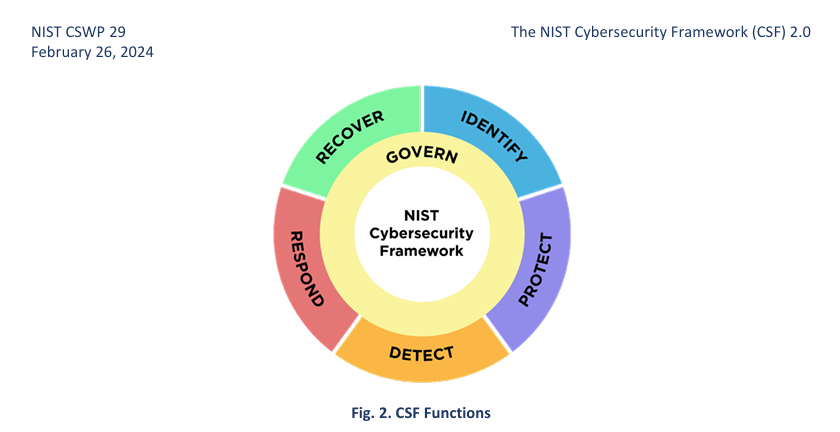
Many organizations structure their **cyber security risk management framework** around the NIST Cybersecurity Framework, which organizes outcomes into six Functions in version 2.0 (Govern, Identify, Protect, Detect, Respond, Recover), with Identify, Protect, Detect, Respond, and Recover still serving as the operational core. Below is an example sequence of **cybersecurity risk management framework steps** that align with these functions and common control activities.
[](https://nvlpubs.nist.gov/nistpubs/CSWP/NIST.CSWP.29.pdf)
*[Image Source: The NIST Cybersecurity Framework (CSF) 2.0](https://nvlpubs.nist.gov/nistpubs/CSWP/NIST.CSWP.29.pdf)*
## Example Framework Steps and Mapped Activities
| Step | Description | Example Control / Activity | Relevant Framework Function |
| --- | --- | --- | --- |
| Inventory and classify assets | Build and maintain an accurate inventory of systems, applications, data, and third parties, grouped by criticality and sensitivity. | Enterprise asset inventory, data classification, and third‑party catalog. | Identify |
| Assess threats and vulnerabilities | Analyze how assets could be compromised and where weaknesses exist. | **IT risk assessments**, vulnerability scans, penetration testing, secure configuration reviews. | Identify/Protect |
| Prioritize and plan controls | Rank risks by likelihood and impact, select mitigation, transfer, or acceptance strategies, and build a roadmap. | Risk register, treatment plan, roadmap aligned to regulations (HIPAA, PCI, etc.). | Govern/Identify |
| Implement protective controls | Deploy and tune technical, process, and administrative controls to reduce prioritized risks. | Access control, encryption, secure baselines, **cloud security** guardrails, and awareness training. | Protect |
| Monitor, detect, and respond | Continuously monitor for anomalies and incidents, and coordinate response. | Log collection, SIEM, EDR, incident response playbooks, and exercises. | Detect/Respond |
| Recover and improve | Restore services, communicate with stakeholders, and feed lessons learned into the program. | Backup and recovery testing, post‑incident reviews, updated controls and procedures. | Recover/Govern |
Operationalizing these steps typically involves a blend of **IT risk assessments and vulnerability management**, targeted penetration testing, periodic **compliance audits**, and structured **incident response** planning and exercises. Authoritative resources such as the [NIST Cybersecurity Framework’s core functions (Identify, Protect, Detect, Respond, Recover)](https://www.nist.gov/cyberframework/getting-started/online-learning/five-functions) and guidance from agencies like CISA help organizations benchmark and mature their programs over time.
[](https://cta-redirect.hubspot.com/cta/redirect/4114417/def6bbf3-2d24-44fc-bfee-3dca9a08a5d6)
## How JANUS Associates Strengthens Your Cyber Risk Posture
JANUS Associates has been assisting clients with information security, cybersecurity testing, and compliance assessments since 1988, earning a reputation for objectivity, on‑time delivery, and excellence in service. As an independent cybersecurity and compliance consulting firm, JANUS focuses solely on clients’ best interests rather than on selling specific technologies.
Key capabilities include:
### Cybersecurity and IT risk assessments
JANUS conducts [**comprehensive cybersecurity and IT risk assessments**](https://janusassociates.com/services/enterprise-risk-compliance/) that evaluate technical, process, and organizational controls against leading standards and your unique risk profile. These engagements help prioritize investments and align your cyber security risk management framework with regulatory and business requirements.
### Advanced Penetration testing and vulnerability management
Senior specialists perform in‑depth penetration testing and vulnerability assessments to uncover subtle exposures that internal teams may miss. Findings are mapped to business impact, enabling practical remediation plans and measurable reductions in risk.
### Compliance and governance
JANUS supports enterprise risk and compliance efforts across frameworks such as NIST, ISO 27001, HIPAA, PCI, [MARS-E, ARC-AMPE](https://janusassociates.com/services/mars-e/), and other emerging requirements like CMMC. Services span policy development, control mapping, and readiness assessments to support smoother [**compliance audits** and ongoing governance](https://janusassociates.com/services/).
### Business resilience and incident response
We help organizations design and exercise incident response, disaster recovery, and broader business resilience capabilities so that critical services can withstand and recover from cyber events. This includes tabletop exercises, playbook development, and integration with enterprise risk management.
For more on how JANUS can support your organization’s risk‑based program, explore our [cybersecurity services and IT risk assessments.](https://www.janusassociates.com/services)
A structured **cyber security risk management approach** turns cybersecurity from a collection of tools into a disciplined, framework‑driven capability that supports compliance, resilience, and strategic growth. By grounding your program in recognized frameworks like the NIST Cybersecurity Framework, applying the 5 C’s and the four risk responses, and investing in the right skills and partners, your organization can move from reactive spending to a proactive, measurable **cyber risk strategy**.
JANUS Associates stands ready to help you assess your current posture, close critical gaps, plan for the future, and operationalize a modern cybersecurity risk management framework tailored to your regulatory and business environment. To take the next step toward a more resilient and compliant program, [schedule a cybersecurity risk assessment with a JANUS cybersecurity expert](https://info.janusassociates.com/request-a-consultation).
Topics: [CIO & CISO Services](https://info.janusassociates.com/blog/tag/cio-ciso-services), [Information Security (InfoSec)](https://info.janusassociates.com/blog/tag/information-security-infosec), [Enterprise Risk & Compliance](https://info.janusassociates.com/blog/tag/enterprise-risk-compliance)
### Topics
- [Business Resilience (22)](https://info.janusassociates.com/blog/tag/business-resilience)
- [Data Breach Protection (16)](https://info.janusassociates.com/blog/tag/data-breach-protection)
- [Employee Security Awareness Training (13)](https://info.janusassociates.com/blog/tag/employee-security-awareness-training)
- [Incident Response (13)](https://info.janusassociates.com/blog/tag/incident-response)
- [Managing Cyber Risks (10)](https://info.janusassociates.com/blog/tag/managing-cyber-risks)
- [CIO & CISO Services (8)](https://info.janusassociates.com/blog/tag/cio-ciso-services)
- [Vulnerability Assessments (8)](https://info.janusassociates.com/blog/tag/vulnerability-assessments)
- [AI and Cybersecurity (7)](https://info.janusassociates.com/blog/tag/ai-and-cybersecurity)
- [Cybersecurity Education (7)](https://info.janusassociates.com/blog/tag/cybersecurity-education)
- [Business Continuity & Disaster Recovery (BCDR) (6)](https://info.janusassociates.com/blog/tag/business-continuity-disaster-recovery-bcdr)
- [Information Security (InfoSec) (6)](https://info.janusassociates.com/blog/tag/information-security-infosec)
- [Ransomware (6)](https://info.janusassociates.com/blog/tag/ransomware)
- [Case Study (5)](https://info.janusassociates.com/blog/tag/case-study)
- [Cyber Insurance (5)](https://info.janusassociates.com/blog/tag/cyber-insurance)
- [Enterprise Risk & Compliance (5)](https://info.janusassociates.com/blog/tag/enterprise-risk-compliance)
- [Penetration Testing (5)](https://info.janusassociates.com/blog/tag/penetration-testing)
- [Cybersecurity Maturity Model Certification (CMMC) (4)](https://info.janusassociates.com/blog/tag/cybersecurity-maturity-model-certification-cmmc)
- [Attack Surface Discovery (ASD) (2)](https://info.janusassociates.com/blog/tag/attack-surface-discovery-asd)
- [Small Business (1)](https://info.janusassociates.com/blog/tag/small-business)
See all
### Cybersecurity Moves Fast. Stay Informed.
[](https://info.janusassociates.com/hs/cta/wi/redirect?encryptedPayload=AVxigLIHetGj7GFmjJZ8PNgKFv4KJhQ5A5pgf6yk4JPmZcHZwP8zH2TY0nNxLRIkACRuc%2FTlwISfGNBtcMBS8dpl7Ft3bc10ca2iKpX2Eb2ikqnYvucOOPJQDdb3kFFYt7l0ZpS0LA7lOHuPmztKjSUyIe2B%2BEsnfqTGZP3zE%2FVf7svUJv8eVTWKTOhwf4c6w4KUiub3&webInteractiveContentId=205217918251&portalId=4114417)
[](https://info.janusassociates.com/hs/cta/wi/redirect?encryptedPayload=AVxigLIcYK1dmZHlH1DmJxx7GbycpUfm7GoN0S2bs%2BxbU5bXlgBEb4V5yOyM3AHEKHsWP2o5ieM8ALyfymLYHDLwrO6VFyQ%2Bng%2BTQgo03JZU8M%2FsAWBPXzAIrj9hafAL5jiO8EzYgjkG7Xuv8QABJtxVqGs6JWeBl5lGCQNoUIU98d8dC0MtYjEV92aTJetsh6CzJbZPc6aBfn2YGEfb6E68YfNm4lX5JU89CpTDhhpABBd0TGo6SYIaWzipSL4ZLnAt%2Fi19fS5znotHS%2BU0zMAFeuSmeNtBhhlJ%2BR6g0%2FVkP9oy8zOngQ%3D%3D&webInteractiveContentId=202638233961&portalId=4114417)
- [Cybersecurity Blog](https://info.janusassociates.com/blog)
- [JANUS Services](https://janusassociates.com/services/)
- [ARC-AMPE (MARS-E) Compliance](https://janusassociates.com/services/mars-e/)
- [Small Business Complete](https://janusassociates.com/services/small-business-complete/)
- [Contact Us](https://janusassociates.com/contact/)
- [Site Map](https://janusassociates.com/page-sitemap.xml)
- [Privacy Policy](https://janusassociates.com/privacy/)
[](https://www.gsaelibrary.gsa.gov/ElibMain/contractorInfo.do?contractNumber=GS-35F-471BA&contractorName=JANUS+SOFTWARE%2c+INC.&executeQuery=YES)
#### JANUS Associates
1200 High Ridge Road
Stamford, CT 06905
Tel: [203.251.0200](tel:203-251-0200)
Fax: 203.251.0222
Email: [info@janusassociates](mailto:info@janusassociates.com?Subject=Janus%20Inquiry)
© 2026 JANUS Associates, Inc.
-
-
-
-
-
```json
{
"@context" : "https://schema.org",
"@type" : "BlogPosting",
"author" : {
"@type" : "Person",
"name" : "Janus Associates",
"url" : "https://info.janusassociates.com/blog/author/janus-associates"
},
"dateModified" : "2026-02-11T18:21:12.261Z",
"datePublished" : "2026-02-11T18:17:35.000Z",
"headline" : "What Is Cybersecurity Risk Management? Frameworks, Skills, and Strategies for Modern Enterprises",
"image" : [ "https://info.janusassociates.com/hubfs/JANUS%20Associates%20Cybersecurity%20and%20Risk%20Management%20Framework.jpg" ],
"mainEntityOfPage" : {
"@id" : "https://info.janusassociates.com/blog/cybersecurity-risk-management-framework-janus-associates",
"@type" : "WebPage"
},
"publisher" : {
"@type" : "Organization",
"logo" : {
"@type" : "ImageObject",
"url" : "https://info.janusassociates.com/hubfs/logo-1.png"
},
"name" : "JANUS Associates"
}
}
```